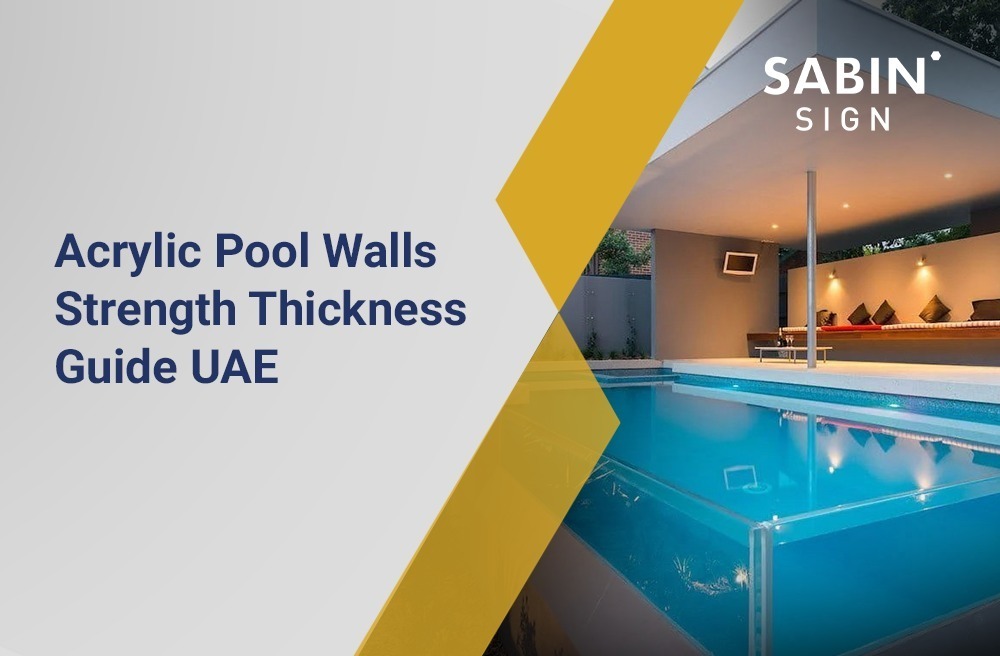
Acrylic Pool Walls Strength Thickness Guide UAE
Transparent pool walls often raise one key question: Is it strong enough?
Despite their glass-like appearance, acrylic panels are engineered to withstand significant forces. Understanding their performance means looking at how loads are transferred, how thickness is determined, and how the material behaves over time. When properly designed, acrylic outperforms many traditional alternatives in both strength and durability.
1. Understanding the Load on a Pool Wall
Pool walls are subjected to hydrostatic pressure, which increases with depth. At the surface, pressure is negligible, but at 1.5 metres it reaches about 14.7 kPa, and at 2 metres around 19.6 kPa.
This pressure acts across the entire panel and is strongest at the base, creating a bending force that must be safely transferred to the supporting structure. The panel must resist this without excessive deflection, cracking, or leakage over time, while also handling temperature changes, UV exposure, chemicals, and occasional impacts.
2. Why Acrylic Is the Preferred Material
Cast acrylic (PMMA) offers a unique combination of strength, clarity, and durability. It is specifically suited for transparent structural applications where both performance and visual quality are critical.
Property | Cast Acrylic | Tempered Glass | Polycarbonate |
Impact Resistance | Very high flexes before fracture | Moderate brittle failure mode | Highest but poor UV stability |
Optical Clarity | Excellent water-white, no tint | Good slight green cast | Good yellows over time outdoors |
UV Resistance (outdoor) | Excellent inherent stabilisers | Excellent | Poor without coating |
Chemical Resistance | High pool chemicals tolerated | High | Moderate degrades with chlorine |
Max. Thickness Available | 100 mm+ (custom feasible) | ~25 mm practical limit | ~50 mm, limited suppliers |
Surface Restorability | Polishable in situ, even underwater | Not polishable | Difficult surface crazes |
Weight vs. Glass | ~50% lighter per equivalent thickness | Baseline | ~45% lighter |
Failure Mode | Plastic deformation no shatter | Catastrophic fracture | Crack propagation |
3. How Acrylic Pool Wall Thickness Is Calculated
Acrylic panel thickness is not chosen arbitrarily it is determined through engineering calculations or established reference charts based on hydrostatic load performance of cast PMMA.
Three key factors define the required thickness:
- Water depth: As depth increases, pressure at the base rises significantly, driving higher bending forces. Deeper pools require disproportionately thicker panels.
- Panel span: The distance between supports has a major impact. Increasing span greatly amplifies bending stress, meaning wider panels need substantially more thickness.
- Support conditions: Panels fixed on all four sides perform very differently from those supported on fewer edges or cantilevered. The support system directly affects load distribution and design requirements.
Indicative Thickness Reference
These ranges apply to standard flat panels under typical residential conditions. Final specifications should always be verified by a qualified structural engineer or the panel manufacturer.
Water Depth | Panel Span (Horizontal) | Indicative Thickness |
Up to 1.0 m | Up to 1.5 m | 30 – 40 mm |
Up to 1.2 m | Up to 2.0 m | 40 – 50 mm |
1.2 – 1.5 m | 2.0 – 3.0 m | 50 – 70 mm |
1.5 – 2.0 m | 3.0 – 4.0 m | 70 – 90 mm |
2.0 m+ | 4.0 m+ | 90 – 100 mm+ (custom) |
One practical detail that is often overlooked: cast acrylic panels hold their nominal thickness to tighter tolerances than glass. A 60 mm panel is 60 mm not 57 mm with ±3 mm variance. This consistency matters when structural calculations are based on a specific section modulus.
4. Panel Geometry: Flat, L-Shaped, and Curved
The cross-sectional shape of an acrylic pool wall panel affects both its structural behavior and the complexity of its installation. There are three primary geometries, each with distinct engineering characteristics.
Flat Side Panels
The most common configuration. A vertical planar panel spanning one face of the pool. Structural behaviour is pure bending the panel resists hydrostatic load entirely through its section thickness and perimeter fixing. Supplied as a single jointless piece where span permits, or with discreet hairline joints for wider openings.
L-Shaped Panels
The vertical wall and a horizontal floor return are fabricated as a single continuous piece. This eliminates the base joint, the most structurally and waterproofing-critical interface in a flat panel assembly, and allows the floor leg to act as a moment restraint, reducing the bending stress in the wall section and, in many cases, the required wall thickness. The preferred solution for elevated pools and spa vessels where the base-to-wall junction carries the highest risk.
Curved Panels
Thermoformed to a defined radius for circular, oval, or free-form pool geometries. Curvature introduces compressive arch action that supplements bending resistance. A correctly radiused panel can carry an equivalent hydrostatic load at a marginally reduced thickness compared to a flat panel of the same span, an efficiency gain that becomes meaningful at larger dimensions.
5. Five Structural Properties That Define the Acrylic Advantage
01 Ductile Failure Mode:
Cast acrylic deforms under extreme stress rather than fracturing like glass. This provides visible warning before failure, offering a critical safety advantage by avoiding sudden, catastrophic water release.
02 Dynamic Load Absorption:
Acrylic’s lower stiffness allows it to absorb dynamic forces such as water movement, pump pressure, and minor structural shifts. This reduces stress transfer and long-term fatigue on joints and supports.
03 Inherent UV Stability:
UV protection is built into the material, not applied as a coating. This ensures long-term clarity and prevents yellowing or degradation, even with surface wear or polishing.
04 In-Situ Surface Restoration
Surface scratches can be polished out on-site without removing the panel, turning potential replacements into simple maintenance tasks.
05 Structural Weight Efficiency
At roughly half the weight of glass, acrylic significantly reduces structural load. In elevated installations, this can minimize or eliminate the need for additional structural reinforcement.
6. The Installation Sequence and Why It Matters
6. Installation Sequence and Why It Matters
Even a perfectly engineered acrylic panel can fail if installation is not executed correctly. The panel and its installation must function as a single integrated system.
Step 1: Rebate Preparation
The pool structure is formed with a recessed rebate to receive the panel. This must align precisely with panel edges and sealant requirements, with tight tolerances (±2–3 mm).
Step 2: Delivery and Handling
Large panels are heavy and require controlled lifting equipment. They must be transported and stored flat with full support. Protective film remains in place until installation is complete.
Step 3: Sealant and Setting
A specialized structural sealant is used to bond the panel, designed to handle chemical exposure and thermal movement. Standard silicone is not suitable.
Step 4: Edge Finishing
Metal capping (aluminum or stainless steel) is applied to protect the joint and provide a clean finish.
Step 5: Staged Filling and Inspection
the pool is filled incrementally, allowing inspection at each stage. Any deflection, leakage, or joint issues are addressed before proceeding.
7. Application Contexts Where Acrylic Pool Walls Excel
Infinity-Edge and Cantilevered Pools
The defining visual characteristic of an infinity pool, the apparent disappearance of the water’s edge, is only fully realized when the pool wall itself is also invisible. An acrylic pool wall, with its water-white optical clarity and absence of any green tint, achieves this in a way that tinted glass cannot. The panel becomes an extension of the water, not a frame around it.
Elevated Residential Pools
Villa and apartment rooftop pools in the UAE increasingly incorporate transparent walls on one or more sides to preserve views from adjacent interior spaces. The weight efficiency of acrylic roughly half that of glass at equivalent thickness, is structurally advantageous when the pool sits above occupied space and the supporting slab has been designed to standard residential loading.
Hotel and Hospitality Pools
In commercial hospitality settings, a transparent pool wall visible from a lobby, restaurant, or outdoor terrace becomes an architectural center piece rather than simply an amenity. The maintenance advantage of acrylic is the ability to restore surface clarity in situ, which is particularly valuable in high-traffic commercial environments where the pool wall is subject to frequent contact and cleaning.
Aquarium Walls and Holding Tanks
The structural and optical properties that make acrylic the preferred material for swimming pool acrylic panels apply equally to commercial aquarium viewing windows and large-volume holding tanks. In these applications, panel thicknesses of 80 mm and above are common, and the requirement for absolute optical clarity at large spans makes cast acrylic the only practical choice.
Spa and Hydrotherapy Vessels
Compact elevated spa vessels, hot tubs, plunge pools, and hydrotherapy baths present a demanding combination of high water temperature, concentrated chemical exposure, and structural depth in a small footprint. Acrylic’s resistance to thermal cycling and pool chemistry, combined with its ability to be molded into complex vessel geometries, makes it the dominant material choice in high-specification spa installations.
8. Evaluating a Supplier: The Right Questions
Acrylic pool wall projects are high-value specifications where supplier capability matters as much as material quality. These are the questions that will separate a well-qualified supplier from one who cannot deliver to the required standard.
- Is the acrylic cast or extruded? Cast PMMA is required for structural pool wall applications. Extruded acrylic has a lower molecular weight and inferior long-term stress resistance.
- Can you provide material certification confirming grade, UV stabilizer content, and optical clarity rating?
- What is your maximum single-piece panel dimension? Joints in pool walls are potential failure points; minimizing them by maximizing panel size is always preferable.
- Do you perform structural thickness calculations in-house, or do you rely solely on reference charts? A supplier with in-house engineering capability can handle non-standard geometries.
- What is the sealant specification, and is it rated for sustained pool chemical exposure and the thermal expansion differential between acrylic and the substrate?
- Do you supply and install as a single responsibility, or supply only? Interface risk where the panel supplier and the installer are different parties is one of the most common causes of acrylic pool wall failures.
- Can you provide documented references for projects of comparable depth and span completed in the past three years?
Conclusion: The Structural Bottom Line
A transparent pool wall is only as good as the engineering behind it. Material choice, thickness calculation, panel geometry, and installation quality are not independent decisions; they are a single interconnected system.
Cast acrylic, correctly specified and properly installed, offers a combination of structural performance, optical quality, surface restorability, and long-term stability that no alternative transparent material matches in aquatic applications. The investment in getting the specification right from the first thickness calculation to the final commissioning inspection is the investment that determines whether a pool wall performs for a decade or for a generation.
The questions to ask of any supplier are not about price. They are about engineering depth, material traceability, and installation accountability. Those are the factors that determine whether the clear panel holding back your pool performs as designed, every day, for the life of the structure.
Contact Sabin Sign Industries.
Ready to specify your acrylic pool wall?
Sabin Sign Industries supplies and installs premium acrylic pool panels and walls across the UAE. Contact us for a project consultation and quotation.