When businesses source plastic components or products, the immediate requirement may seem straightforward: manufacture the product to specification, at the required quality, quantity and timeline.
But as requirements become more complex, products evolve or production volumes increase, the relationship with the manufacturer can become much more important.
A product supplier primarily fulfils an order. A manufacturing partner understands the wider requirement, contributes technical expertise and supports the product as production needs evolve.
For businesses looking beyond a single order, this difference can create significant long-term value.
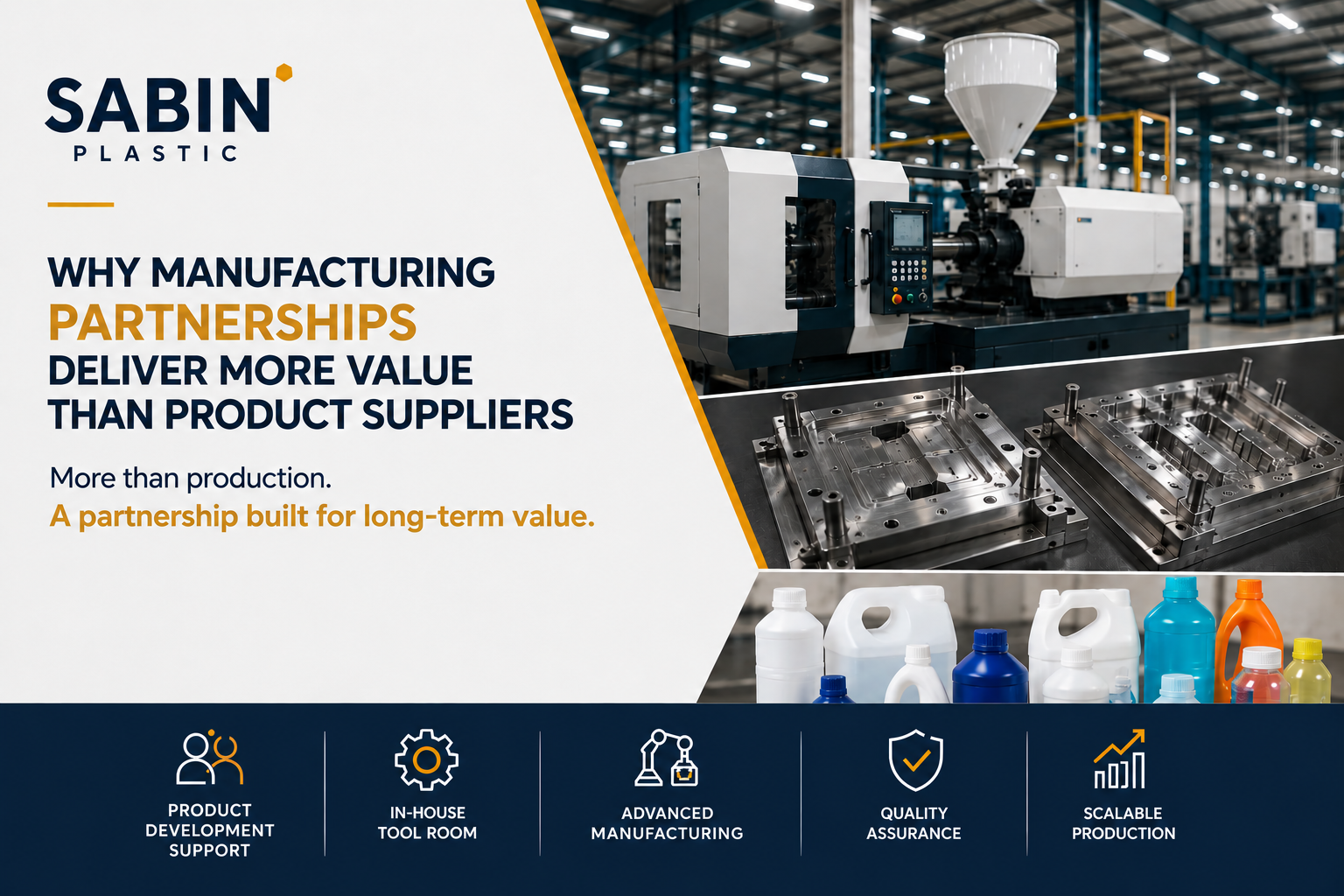
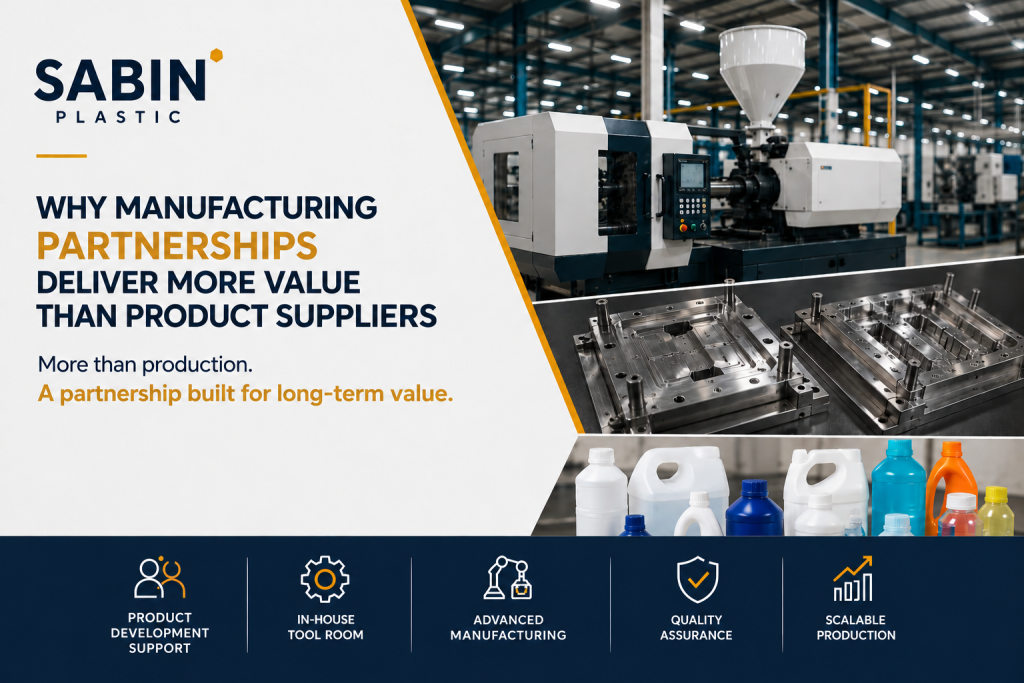
At Sabin Plastic Industries, manufacturing capabilities across product development, engineering, tooling, injection moulding and blow moulding support customers at different stages of their manufacturing requirements.
A Supplier Fulfils a Specification. A Partner Understands the Requirement.
A specification explains what needs to be produced. But understanding why the product is being produced, how it will be used and what the customer needs from it can influence how effectively it is manufactured.
A manufacturing partnership therefore begins with understanding the requirement rather than simply receiving an order.
Depending on the project, this may involve considering:
- Product application and functional requirements
- Design and dimensions
- Material requirements
- Production quantities
- Tooling requirements
- Manufacturing method
- Finishing or assembly requirements
- Future production needs
This broader understanding allows manufacturing decisions to be considered in the context of the finished product and its intended use.
Manufacturing Expertise Can Add Value Before Production Begins
Some of the most important manufacturing decisions happen before full-scale production starts.
A design may need to be evaluated for manufacturability. A particular feature may affect tooling. A prototype may reveal an opportunity for improvement. The expected production volume may influence how the mould or manufacturing process should be approached.
Bringing manufacturing expertise into the process earlier can help identify these considerations before they become production-stage challenges.
At Sabin Plastic Industries, engineering, prototyping and an in-house Tool Room support this development process.
The value of these capabilities is not simply that they are available. It is that product development, tooling and manufacturing requirements can be considered in relation to one another.
For customers, this can support a smoother transition from an initial requirement to repeatable production.
The Relationship Doesn’t End When Production Starts
Manufacturing requirements rarely remain completely static.
Over time, a customer may need to modify a product, adjust quantities, maintain or repair tooling, develop another component or respond to changing market requirements.
This is where a longer-term manufacturing relationship can provide value beyond the original production order.
An in-house Tool Room, for example, can support mould development, modification, repair and maintenance as requirements evolve.
Similarly, having both injection moulding and blow moulding capabilities provides flexibility across different types of plastic products.
Injection moulding can support engineered and custom moulded components, while blow moulding is used for hollow products such as bottles, jars and jerry cans.
The objective is not to fit every requirement into one manufacturing process, but to apply the appropriate capability according to the product.
Consistency Becomes More Important as Production Scales
Producing an initial batch successfully is one requirement. Maintaining consistency across repeat production is another.
As quantities increase, variations that may appear minor at smaller volumes can become significant. Product dimensions, material behaviour, production methods and process control all influence repeatability.
This makes manufacturing consistency a business requirement, not simply a production metric.
Sabin Plastic Industries follows the manufacturing principle of the 4Ms:
Men — skilled professionals with manufacturing and technical expertise
Machine — production and tooling equipment suited to the manufacturing requirement
Method — structured and repeatable manufacturing processes
Material — appropriate material selection based on product requirements
Together, these elements support the consistency required for reliable repeat production.
For customers, greater consistency can mean fewer production uncertainties and greater confidence as requirements grow.
Flexibility Creates Long-Term Business Value
A customer’s manufacturing requirement today may not be the same requirement a year from now.
Volumes can increase. Designs can change. New products can be introduced. Existing moulds may require modification or maintenance. Additional manufacturing processes may become necessary.
A manufacturing partner should therefore be capable of supporting change as well as production.
Having engineering, tooling, injection moulding and blow moulding capabilities within a coordinated manufacturing environment allows different requirements to be addressed as a customer’s product portfolio develops.
This flexibility can be particularly valuable for businesses looking for a manufacturing relationship that can grow alongside their requirements rather than sourcing a new supplier every time something changes.
Manufacturing Capability Is Only Part of the Partnership
Machines and production capacity matter, but they do not define a manufacturing partnership on their own.
Communication, technical understanding, responsiveness, quality and the ability to solve manufacturing challenges all influence the long-term relationship.
When evaluating a manufacturing partner, businesses should therefore consider questions such as:
- Can the manufacturer understand the application, not just the drawing?
- Can they provide engineering and product-development support where required?
- Is tooling capability available?
- Can tooling be maintained or modified as requirements change?
- Are the appropriate manufacturing processes available?
- How is production consistency maintained?
- Can the manufacturer support repeat and growing production requirements?
- Is there clear communication when technical or production issues arise?
The right partner should provide confidence not only for the first production order, but for what happens afterwards.
From Transactional Supplier to Long-Term Manufacturing Partner
There will always be manufacturing requirements where a straightforward supplier relationship is sufficient.
But for custom products, repeat production and requirements that may evolve over time, manufacturing can become a more strategic relationship.
A manufacturing partner can contribute before production begins, support tooling throughout its working life, maintain consistency during repeat production and adapt as the customer’s requirements change.
At Sabin Plastic Industries, product development, engineering, an in-house Tool Room, injection moulding and blow moulding capabilities provide the manufacturing foundation to support customers across different stages of this journey.
Ultimately, the distinction is simple:
A supplier delivers products. A manufacturing partner helps build better ones.
Looking for a manufacturing partner for your next product or production requirement?
Speak to the Sabin Plastic Industries team about your product, tooling and manufacturing requirements.