
When selecting materials for a project, price is naturally an important consideration. But the lowest initial price does not always translate into the best value.
The material also needs to suit the application, environment, fabrication process, appearance and expected performance. An unsuitable choice can create fabrication or installation challenges, increase maintenance requirements or result in premature replacement.
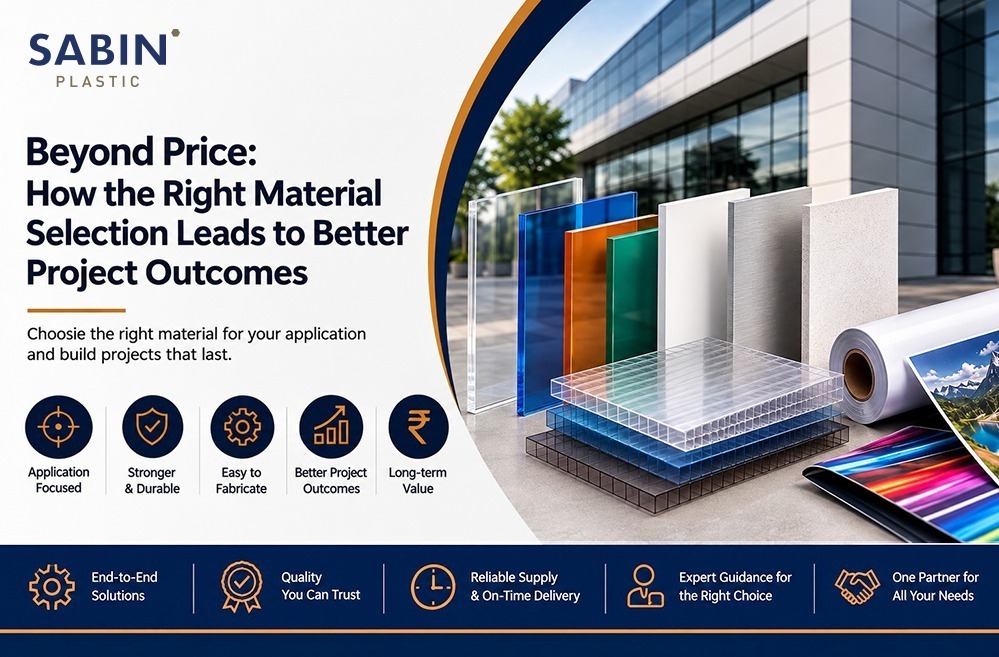
At Sabin Plastic Trading, we work with project teams, fabricators, designers and procurement professionals across a wide range of applications. From acrylic and polycarbonate sheets to ACP, PVC foam boards and print media, each material performs differently. Understanding those differences is the first step towards making a better purchasing decision.
Why Does Material Selection Matter?
A material that works well for an indoor retail display may not be appropriate for an exposed outdoor application. Similarly, a material selected primarily for optical clarity may not provide the impact resistance required for another project.
The right selection starts with the application.
Before comparing prices, consider:
- Where will the material be used?
- Is the application indoor or outdoor?
- What strength or impact resistance is required?
- Is optical clarity important?
- What colour, texture or finish is required?
- Will the material be cut, routed, bent, formed or printed?
- What thickness or grade does the application require?
- What maintenance will be required?
- What is the expected service life?
- Is the required specification available within the project programme?
These considerations help narrow the options before price becomes the deciding factor.
Choosing the Right Material by Application
Different sheet materials solve different project requirements. Here are some of the key considerations when evaluating commonly used materials.
Acrylic Sheets: Clarity and Design Flexibility
Acrylic is widely used when appearance, optical clarity, colour and fabrication flexibility are important.
Typical applications include:
- Retail displays
- Signage
- Interior features
- Lighting applications
- Point-of-sale displays
- Architectural details
- Custom fabricated products
Acrylic is available in different colours, finishes, thicknesses and grades, so simply specifying “acrylic” may not be enough.
For example, a premium retail display may prioritise surface finish and colour consistency, while a fabricated component may require a particular thickness and grade based on the cutting, bending, bonding or forming process.
The appropriate acrylic should therefore be selected according to both the finished application and the fabrication method.
Polycarbonate Sheets: Impact Resistance for Demanding Applications
Where impact resistance and durability are greater priorities, polycarbonate may be a more suitable option.
Depending on the product type and specification, polycarbonate sheets are used for applications including:
- Canopies
- Skylights
- Roofing
- Glazing
- Protective barriers and guards
- Architectural applications
- Industrial applications
For an outdoor canopy or skylight, for example, material selection should consider more than sheet price. Exposure conditions, UV protection, light transmission, required strength, sheet type, thickness and installation requirements can all affect the choice.
This is also why acrylic and polycarbonate should not automatically be treated as interchangeable materials. Each has different characteristics and should be selected according to the application.
ACP Sheets: Versatility for Architectural and Commercial Applications
Aluminium Composite Panels (ACP) are widely used across architectural, signage, interior and commercial applications.
Typical applications include:
- Exterior cladding
- Interior wall features
- Signage
- Fascias
- Retail environments
- Commercial interiors
ACP is available in a wide range of colours and finishes, allowing designers to achieve different visual effects across a project.
However, appearance is only one consideration. The required panel specification, intended environment, fabrication method, installation system and project requirements should also be reviewed when selecting an ACP product.
Choosing the correct specification at the beginning helps ensure that the material is appropriate for how and where it will ultimately be used.
PVC Foam Boards: Lightweight and Easy to Fabricate
PVC foam board is a practical option for applications where low weight, ease of handling and fabrication are important.
Common applications include:
- Signage
- Display panels
- Point-of-sale displays
- Exhibition stands
- Interior applications
- Models and prototypes
- Engraving
- Panel work
For temporary displays and exhibition applications, for example, ease of transportation, cutting and installation can be just as important as the initial material cost.
The appropriate board thickness and specification should therefore be selected according to the required rigidity, finish, fabrication process and intended application.
Print Media: Selecting the Right Substrate for the Application
The material decision is equally important in printing and visual communication.
Print media includes a broad range of substrates for signage, advertising, retail graphics, events, exhibitions, interiors and branded environments.
Depending on the application, this can include:
- Self-adhesive vinyl
- Banner and flex materials
- Floor graphics and laminates
- Wallpapers
- Textiles
- Speciality large-format printing media
A vinyl intended for a short-term indoor promotion, for example, may have very different requirements from graphics being installed outdoors or on a floor.
When selecting print media, project teams should consider the intended surface, indoor or outdoor exposure, printing technology, required finish, application method and expected duration of use.
What Can Happen When the Wrong Material Is Selected?
A lower upfront price can quickly lose its advantage if the material is unsuitable for the application.
Potential consequences include:
- Additional fabrication requirements
- Difficulty during installation
- Poor visual results
- Increased maintenance
- Premature deterioration
- Material replacement
- Project delays
- Additional labour and associated costs
This is why material value should be assessed across the complete application rather than simply comparing the price per sheet or roll.
How Sabin Plastic Trading Supports Material Selection
Choosing between materials is not always as straightforward as comparing specifications on a product sheet.
A customer may know the required application without knowing the most appropriate material, grade, thickness or finish. In other cases, a specification may already exist and the requirement is to source the correct product reliably and within the project programme.
Sabin Plastic Trading supports customers during the enquiry and quotation process by understanding the application and helping identify suitable material options from our product range.
Our portfolio includes acrylic sheets, polycarbonate sheets, ACP, PVC foam boards, print media and other materials used across construction, signage, fabrication, retail, interior and industrial applications.
The objective is simple: match the material to the application rather than selecting on price alone.
Frequently Asked Questions
How do I choose the right sheet material for my project?
Start with the application rather than the material. Consider whether it will be used indoors or outdoors, the required strength, appearance, fabrication method, thickness, maintenance requirements and expected service life. These factors help determine which material and specification are most appropriate.
When should I choose acrylic instead of polycarbonate?
Acrylic is commonly selected when optical clarity, appearance, colour and design flexibility are priorities. Polycarbonate is often considered for applications where higher impact resistance is important. The final choice should depend on the specific application and required performance.
What should I consider when selecting acrylic sheet thickness?
Thickness depends on factors such as the dimensions of the component, application, support conditions, fabrication method and required rigidity. There is no single thickness suitable for every acrylic application.
Can the same material be used for indoor and outdoor applications?
Not necessarily. Outdoor applications can introduce additional requirements such as UV exposure, weather conditions and temperature changes. The appropriate material grade and specification should therefore be confirmed for the intended environment.
What is the difference between ACP and PVC foam board?
ACP consists of aluminium skins bonded to a core and is commonly used for architectural, cladding, signage and interior applications. PVC foam board is a lightweight plastic board commonly used for displays, signage, exhibitions and interior applications. They serve different performance and fabrication requirements.
Why shouldn’t material selection be based on price alone?
A lower-priced material can become more expensive if it creates fabrication difficulties, requires greater maintenance or needs to be replaced earlier. Comparing suitability, performance and expected service life alongside price provides a better picture of overall value.
Make the Right Material Decision for Your Project
The best material is not necessarily the most expensive or the least expensive. It is the one that best matches the requirements of the job.
By considering application, environment, performance, appearance, fabrication, maintenance and project timelines from the beginning, project teams can make more informed purchasing decisions and reduce the risk of unnecessary rework or replacement.
Need help selecting the right material?
Speak to the Sabin Plastic Trading team about your application, specifications and project requirements, and we can help you identify suitable options from our material range.