When businesses plan a new plastic component, attention usually goes to the design, the material and the unit price. One decision that quietly shapes all three is how molten plastic reaches the cavity inside the mould.
This is the role of the runner system. The choice between a hot runner mould and a cold runner mould can influence material usage, cycle time and tooling investment. It is rarely a question of which is better. It is a question of which is better suited to the product and its production requirements.
At Sabin Plastic Industries, injection moulding capabilities include both hot and cold runner moulds, supported by an in-house Tool Room.
Understanding the Runner System in Injection Moulding
In a runner system for injection moulding, channels carry molten plastic from the machine nozzle to each cavity. How these channels are designed affects how evenly the cavities fill, how much material is used and how quickly each cycle can be completed.
The two main approaches differ in one important way: what happens to the plastic left in the channels after each shot.
Cold Runner Moulds: Simplicity and Lower Tooling Investment
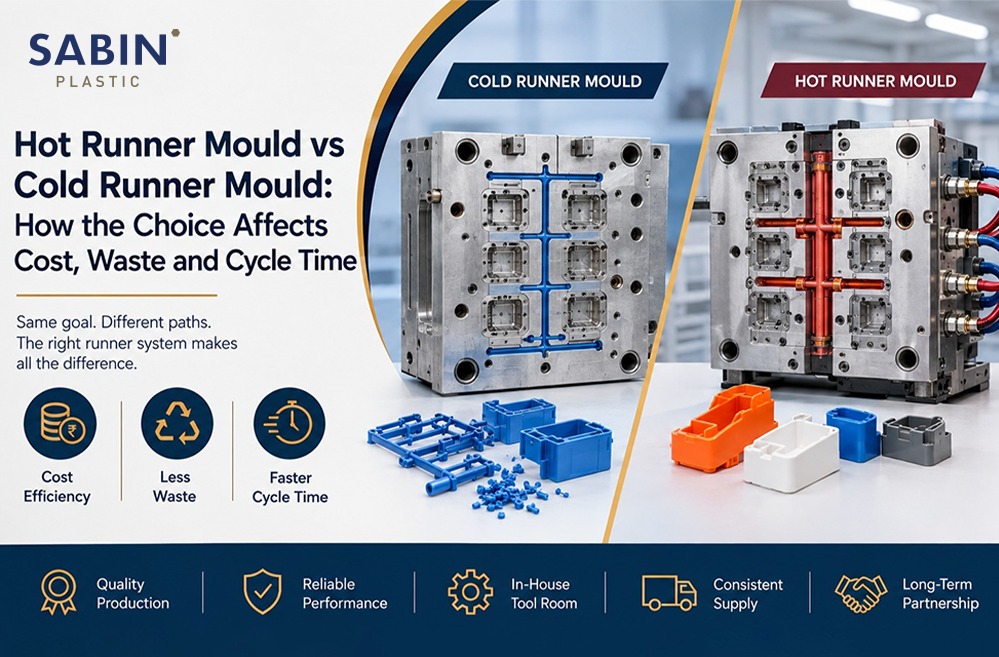
In a cold runner mould, the plastic in the runner cools and solidifies along with the part. The runner is ejected with the moulded product and then separated.
This approach can offer:
- Simpler mould construction
- Lower initial tooling investment
- Easier maintenance
- Straightforward colour and material changes
- Suitability for prototypes and lower production volumes
The trade-off is that the solidified runner is additional material that does not form part of the final product. The runner must also cool before ejection, which can affect cycle time.
Hot Runner Moulds: Efficiency as Volumes Grow
In a hot runner mould, a heated runner system keeps the material molten between injection cycles, reducing or eliminating the solidified runner waste associated with conventional cold runner systems. Depending on the material, product geometry and mould design, this can improve material efficiency and potentially reduce cycle time.
Depending on the application, this can support:
- Reduced material waste
- Shorter cycle times
- Less post-moulding handling
- Greater control over how plastic enters the cavity
The trade-off is a higher initial investment and a more complex system to design and maintain. Colour changes can also be more involved.
Why Hot Runner Mould Design Matters
A hot runner system adds value only when it is designed correctly for the product.
Hot runner mould design involves considering factors such as manifold layout, temperature control, gate type and gate location in relation to the material and part geometry. These decisions affect fill consistency and part quality across production.
This is where tooling expertise becomes important. When mould design and manufacturing are handled in-house, the runner system can be considered alongside the product, material and expected production volume rather than in isolation.
Cost, Waste and Cycle Time: Weighing the Trade-Off
The decision often comes down to balancing upfront investment against long-term efficiency.
- Cold runner moulds typically require a lower initial investment, which can suit prototypes, shorter runs or products with frequent colour changes.
- Hot runner moulds typically involve a higher initial investment, but reduced waste and shorter cycles can become more valuable as production volumes grow.
The right answer depends on the application. A mould for a low-volume component may not justify the added cost of a hot runner system. A product in sustained, high-volume production may benefit significantly from one.
Where This Applies Across Injection Moulded Products
Sabin Plastic Industries manufactures injection-moulded components across construction, electrical, insulation and industrial applications, alongside custom moulded products.
Each product has different requirements for material, geometry, production volume and tooling investment. These factors help determine whether a hot runner or cold runner system is more appropriate.
Our injection moulding capabilities also include single cavity, multi cavity, insert type, prototype, 2K and preform moulds, giving customers flexibility as requirements change.
Questions to Ask Before Investing in a Custom Mould
Before deciding on a runner system, businesses should consider questions such as:
- What production volumes are expected, now and in the future?
- How significant is the material cost for this product?
- Will colour or material changes be frequent?
- How does the part design influence gate position and cavity layout?
- Can the manufacturer design, modify and maintain the mould in-house?
- How does the upfront tooling cost compare with the long-term cost of production?
The right manufacturer should help evaluate these questions, not simply quote for a mould.
Choosing the Right Runner System
There is no universal answer to the hot runner mould vs cold runner mould question. Cold runner moulds offer simplicity and lower upfront investment. Hot runner moulds offer efficiency that can become more valuable at scale.
At Sabin Plastic Industries, in-house tooling, injection moulding and engineering support help customers assess the right approach for each product.
Ultimately, the distinction is simple:
A cold runner mould reduces what you spend to start. A hot runner mould can reduce what you spend to keep going.
Planning a new injection-moulded product or evaluating your tooling options? Speak to Sabin Plastic Industries about your product specifications, expected production volumes and mould requirements.