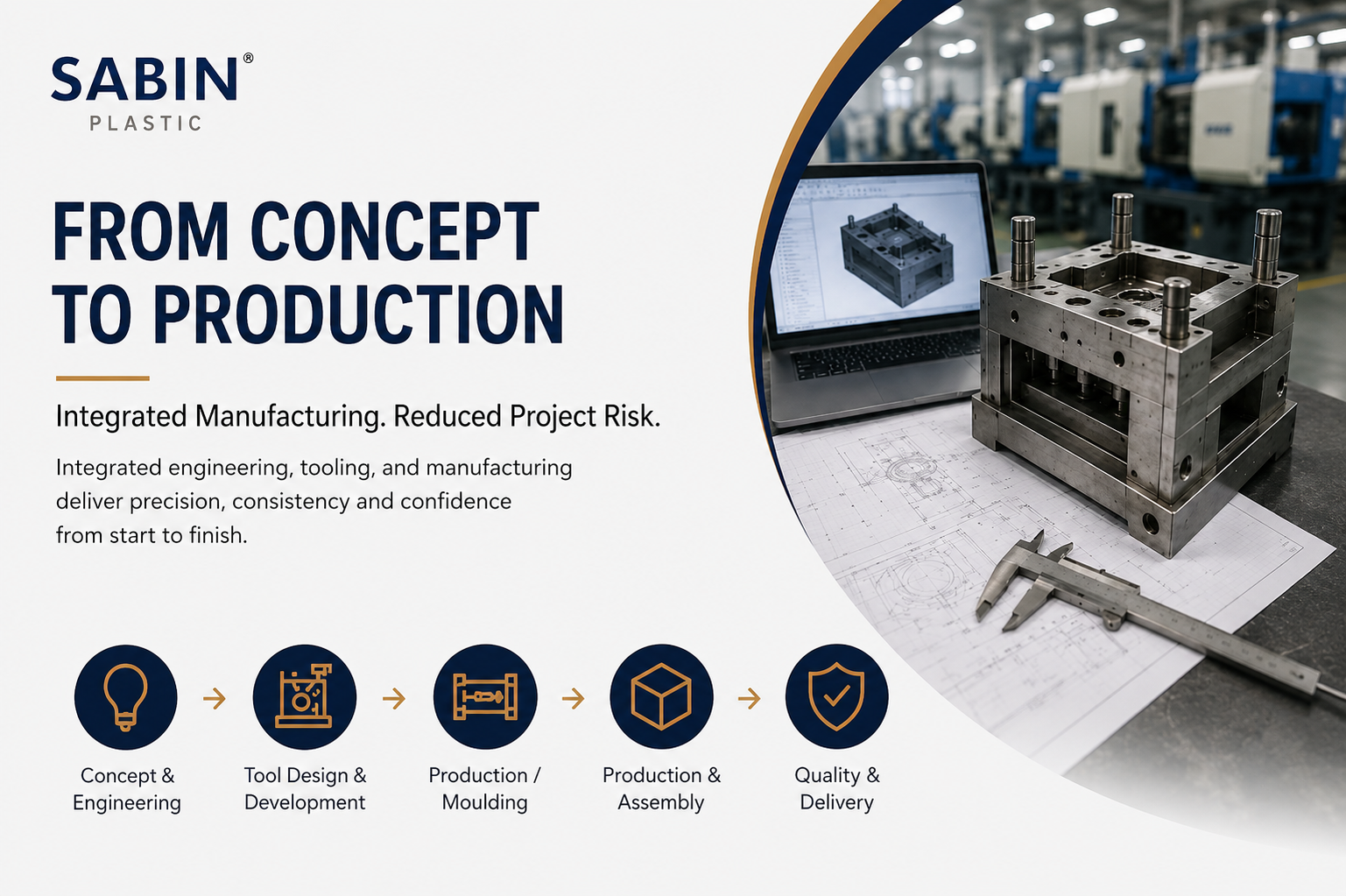
Developing a plastic product involves more than manufacturing a part. Engineering, prototyping, tooling and production all influence the quality, cost and reliability of the finished product.
When these stages are handled by different suppliers, every handover can introduce delays, communication gaps and production challenges.
At Sabin Plastic Industries, engineering and tool development work alongside injection moulding, blow moulding and production capabilities within a coordinated manufacturing environment. This integrated approach helps identify potential challenges earlier and provides greater control as a product moves from concept to production.
Why Integrated Plastic Manufacturing Matters
A conventional product-development process may involve one company developing the design, another manufacturing the mould and a third handling production.
If a design needs modification during tooling or a production trial identifies an issue, information has to move between several parties before it can be resolved.
Bringing key capabilities together creates a more connected process where engineering decisions can consider tooling requirements and tooling can be developed with the final manufacturing process in mind.
For customers, this can mean:
- Fewer supplier handovers
- Better coordination between engineering, tooling and production
- Earlier identification of manufacturing challenges
- Faster resolution of technical issues
- Greater control over tooling
- More consistent production
- Clearer accountability
From Product Idea to Production
Every manufacturing project begins with understanding what the product needs to do.
At Sabin Plastic Industries, projects can progress through a structured development process:
- Requirement Review
Understanding the product application, specifications, dimensions and production requirements. - Engineering & Design
Translating the concept into engineering drawings while considering functionality and manufacturability. - Prototyping & Testing
Where required, prototypes allow the design to be evaluated before moving into full production tooling. - Tool Design & Development
Moulds and tooling are developed according to the product design and selected manufacturing process. - Manufacturing & Production
The product moves into injection moulding or blow moulding, followed by production and assembly where required.
Connecting these stages helps identify potential design and manufacturing issues earlier, before they become expensive production-stage problems.
In-House Tooling: Connecting Design With Production
Tooling is a critical link between product design and repeatable manufacturing.
Sabin Plastic Industries operates an in-house tool room supporting the development, repair and maintenance of precision dies, moulds and press tools.
Keeping tooling closely connected to production helps reduce dependence on external suppliers and allows tooling modifications or maintenance requirements to be addressed more efficiently.
For customers developing custom plastic products, this means the team responsible for production can work directly with the team responsible for the mould — creating a much shorter technical feedback loop.
Injection Moulding or Blow Moulding?
The appropriate manufacturing process depends on the product’s design, material, dimensions, application and production requirements.
Injection Moulding
Injection moulding is suited to repeat production of plastic components where dimensional consistency and repeatability are important.
Sabin’s injection moulding capabilities support engineered components and custom plastic products, with tooling, moulding and production working within the same manufacturing workflow.
Blow Moulding
Blow moulding is primarily used for hollow plastic products.
Sabin’s capabilities include the production of:
- Bottles
- Jars
- Jerry cans
- Other hollow plastic containers
Production capabilities extend to products with capacities of up to 5 litres.
Having both injection and blow moulding capabilities allows the manufacturing method to be selected according to the product requirement rather than adapting every product to a single process.
How Does Integrated Manufacturing Reduce Project Risk?
The biggest advantage is not simply having multiple machines under one roof. It is the connection between the different stages of production.
If a prototype reveals a design issue, a mould requires modification or a production trial identifies an improvement, the relevant teams can coordinate directly.
This can help reduce:
- Repeated communication between different suppliers
- Tooling delays
- Design-to-production gaps
- Unnecessary revisions
- Production inconsistencies
It also creates clearer accountability because the product is being managed through a connected manufacturing process rather than passed between unrelated suppliers.
The 4Ms Behind Manufacturing Consistency
Sabin Plastic Industries follows the manufacturing principle of the 4Ms:
Men — skilled professionals with manufacturing expertise.
Machine — production and tooling equipment supporting precision manufacturing.
Method — structured and repeatable manufacturing processes.
Material — appropriate material selection according to the product requirements.
Together, these elements support consistency across the manufacturing process.
One Manufacturing Partner from Concept to Production
Integrated manufacturing creates continuity from the initial product requirement through to final production.
Concept → Engineering → Prototyping → Tooling → Manufacturing → Production
By connecting these capabilities, Sabin Plastic Industries can support customers across multiple stages of product development rather than operating only as the final production supplier.
The result is fewer unnecessary handovers, better coordination and greater control as a product moves towards repeatable production.
Frequently Asked Questions
What is integrated plastic manufacturing?
Integrated manufacturing connects product engineering, tooling and manufacturing within a coordinated workflow, helping reduce supplier handovers and improve control throughout product development and production.
Why is in-house tooling important?
In-house tooling keeps mould development and maintenance closer to production, making it easier to address modifications, maintenance requirements and production-related tooling issues.
What is the difference between injection moulding and blow moulding?
Injection moulding is commonly used for solid plastic components and engineered parts, while blow moulding is primarily used for hollow products such as bottles, jars and jerry cans.
Can Sabin support a product from concept to production?
Sabin Plastic Industries has capabilities spanning engineering, prototyping, tooling, injection moulding, blow moulding, production and assembly. The exact process depends on the individual product and project requirements.
What information is needed to start a custom manufacturing project?
A product concept or drawing, intended application, dimensions, preferred material if known, expected quantities and functional requirements provide a useful starting point for technical evaluation.
From Concept to Production
Developing a new plastic product requires the engineering, tooling and manufacturing process to work together.
With integrated engineering, in-house tooling, injection moulding and blow moulding capabilities, Sabin Plastic Industries supports customers from initial product requirements through to production.
Have a product requirement or manufacturing enquiry?
Speak to the Sabin Plastic Industries team about your product, tooling and production requirements.