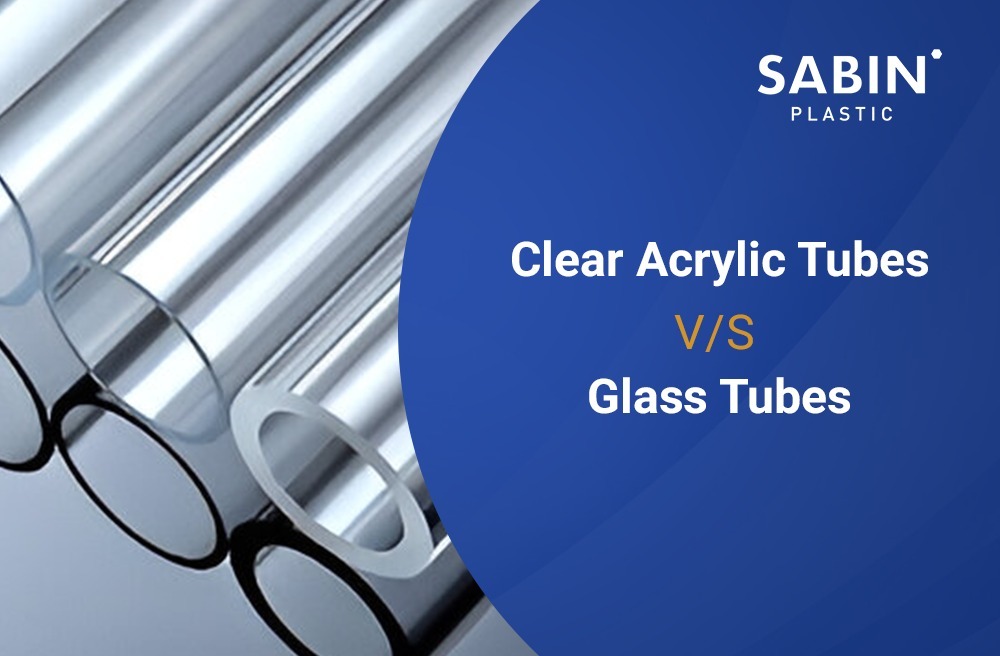
Clear Acrylic Tubes vs Glass Tubes: Cost, Strength & Durability
For any commercial or industrial project in Saudi Arabia, selecting clear acrylic tubes or glass tubes involves more than just selecting a transparent material. It’s a choice that impacts your team’s safety, your project’s overall costs, and the long-term performance of your installation. If you are working on projects in Riyadh, Jeddah, Dammam or any other cities in KSA, understanding these distinctions helps inform material selection for applications ranging from architectural elements and custom lighting installations to retail displays and exhibition stands. Both materials look fantastic and do the job, but when you look at the specifics of cost, strength, and long-term durability, they’re surprisingly different.
Material Overview: Acrylic (PMMA) vs Glass Tubes
PMMA, or polymethyl methacrylate, is used to make clear acrylic tubes. They have the necessary crystal-clear appearance and are made by casting or extrusion techniques. They are found in modern architectural designs, shops, exhibition spaces, and lighting fixtures. In commercial applications, they are almost the norm for transparent tubing.
The traditional silica-based glassmaking technique, which combines heat and molding to create the final product, is used to make glass tubes. Glass has been the material of choice for transparent applications for many generations, and it still has a role. The issue is that modern acrylic alternatives are seriously endangering glass, especially given Saudi Arabia’s severe climate.
Understanding the Full Cost Equation: Acrylic vs Glass
Material Cost Differences: Acrylic vs Glass
Clear acrylic tubes offer a significant cost advantage. In most commercial applications, they typically cost 50 to 70 percent less than glass tubes of comparable size and quality. For bulk material procurement across projects in Riyadh, Jeddah, or Dammam, this cost differential can have a substantial impact on overall project budgets.
For example, a standard clear acrylic tube with a 2-inch diameter and 1/8-inch wall thickness typically costs between SR 30 and SR 55 per meter. A comparable glass tube of the same specifications generally ranges from SR 90 to SR 150 per meter. This cost difference becomes particularly significant when procuring large quantities for major commercial or industrial projects.
This pricing advantage remains consistent across both small-diameter tubes used for display accents and large-diameter tubes specified for major architectural installations. Across applications, acrylic consistently presents a lower material cost compared to glass.
Logistics, Handling & Installation Costs
Weight is a significant practical consideration. Acrylic tubes weigh approximately half as much as comparable glass tubes. When transporting materials between Riyadh, Jeddah, and the Dammam-Khobar region, this reduced weight directly contributes to lower shipping and handling costs.
The impact extends beyond transportation considerations. Glass tubes typically require specialized handling equipment and skilled labor due to their fragile nature. This increases installation complexity and associated labor costs. Acrylic tubes, by contrast, allow for safer handling and more efficient installation processes, enabling faster project execution and reduced labor requirements.
Evaluating Long-Term Performance and Value
For indoor commercial environments such as shopping malls, hotels, and office buildings across the Kingdom of Saudi Arabia, acrylic tubes provide strong long-term value. Lower initial material costs are combined with reduced breakage risk and simplified maintenance requirements, resulting in improved life cycle cost efficiency.
For outdoor applications, durability under prolonged sun exposure is often a key consideration. UV-stabilized acrylic formulations are engineered to withstand the intense solar conditions typical of the Saudi climate. In outdoor environments, these materials demonstrate performance comparable to glass, significantly reducing the durability gap between the two options.
Evaluating Long-Term Performance and Value
Impact Resistance & Safety in High-Traffic Environments
Acrylic demonstrates a clear performance advantage in impact resistance. Standardized testing shows that clear acrylic tubes are approximately seventeen times more impact resistant than glass.
This significantly higher toughness reduces the likelihood of breakage in high-traffic environments such as shopping malls in Riyadh, crowded exhibition halls, and public installations across Jeddah and Dammam. Over the lifecycle of a project, this results in fewer incidents, reduced material replacement, and lower overall maintenance costs.
Safety considerations further strengthen this advantage. Glass failure typically produces sharp fragments that pose immediate injury risks and liability concerns, requiring urgent cleanup and disruption. Acrylic behaves differently under stress. Even when damaged, it does not shatter into hazardous shards and generally remains intact. In commercial spaces with continuous pedestrian movement, this material behavior represents a substantial safety benefit.
Structural Performance: Rigidity vs Flexibility
Glass offers certain advantages in structural performance. Its higher rigidity and compressive strength make it suitable for applications involving elevated internal pressure or where precise dimensional stability is required. Glass also exhibits minimal thermal expansion, allowing it to maintain consistent dimensions under temperature variation.
Acrylic, by contrast, provides greater flexibility, which can be advantageous in practical installations. This flexibility helps reduce the risk of stress fractures that can occur in more rigid materials when minor shaping is required or when operating under fluctuating temperature conditions. Material selection should therefore be based on the specific functional and environmental requirements of the application.
Durability & Longevity
Surface Durability and Maintenance Considerations
Glass offers superior scratch resistance and can withstand years of cleaning and frequent handling while maintaining a pristine surface. Acrylic, by comparison, is more susceptible to developing fine surface scratches over time, particularly when improper cleaning methods are used.
In long-term commercial applications, acrylic provides a practical advantage. Minor surface scratches can often be polished out, restoring the material’s original clarity without replacement. Glass does not offer this flexibility, as scratched surfaces typically require full replacement. In commercial environments where visual standards must be maintained under real-world operating conditions, the ability to repair rather than replace transparent components can deliver measurable cost and maintenance efficiencies.
UV Performance Under Saudi Climate Conditions
Standard acrylic formulations can experience yellowing and increased brittleness when exposed to prolonged and intense solar radiation. This limitation does not apply to UV-stabilized acrylic grades engineered for outdoor use in the Middle East. These formulations are designed to maintain optical clarity and mechanical strength under sustained exposure to high UV levels, delivering outdoor performance comparable to glass.
Glass is inherently resistant to ultraviolet degradation and retains its appearance and structural properties over extended periods. For outdoor installations or applications with significant exposure to direct sunlight in the Kingdom of Saudi Arabia, both UV-stabilized acrylic and glass offer reliable long-term performance when correctly specified.
Chemical Compatibility and Cleaning Performance
Glass demonstrates excellent chemical resistance and is largely unaffected by most cleaning agents and solvents, which is why it is widely specified for laboratory environments. Its inert nature allows for repeated cleaning without risk of surface degradation or chemical reaction.
Clear acrylic tubes are compatible with most standard commercial cleaning products. However, exposure to certain solvents or aggressive chemical agents can cause surface damage. For typical commercial displays and architectural applications using conventional maintenance products, acrylic performs reliably. In specialized environments, chemical compatibility should be verified during material specification.
Thermal Performance and Operating Limits
Glass offers excellent resistance to high temperatures, with many glass types capable of withstanding sustained exposure above 500°C without softening or deformation. This makes glass suitable for applications involving elevated thermal loads.
Clear acrylic begins to soften at temperatures in the range of approximately 80°C to 100°C. In most indoor commercial environments within climate-controlled buildings across the Kingdom of Saudi Arabia, operating temperatures remain well below this threshold. However, applications involving significant heat sources or prolonged exposure to extreme outdoor conditions require careful material evaluation to ensure thermal stability and long-term performance.
Service Life and Long-Term Durability
In modern, climate-controlled commercial buildings, which represent the majority of commercial real estate across the Kingdom of Saudi Arabia, both materials can deliver decades of reliable service when properly maintained. Glass generally retains its appearance and optical clarity for longer periods under demanding conditions.
In high-traffic commercial environments, acrylic often demonstrates greater practical longevity due to its higher impact resistance. While periodic surface polishing may be required, the reduced risk of breakage typically results in fewer replacements compared to glass, contributing to lower long-term maintenance and replacement costs.
Project-Based Material Selection Guide
When Clear Acrylic Tubes Are the Right Choice
Cost-sensitive projects requiring bulk materials
High-traffic public areas where impact resistance matters
Projects where weight affects transportation or installation
Climate-controlled indoor commercial spaces
Safety-critical installations avoiding sharp breakage hazards
Retail displays, exhibition stands, and architectural features
Projects with tight timelines requiring faster handling and installation
When Glass Tubes Are the Preferred Choice
Applications demanding maximum optical clarity over decades
High-temperature environments
Chemical-resistant applications
Projects requiring zero thermal expansion
Prestige installations where traditional glass aesthetics matter
Laboratory or specialized scientific equipment
Installations where scratch resistance is non-negotiable
Clear Acrylic Rods & Tubes Available Across Saudi Arabia
From display accents to lighting and architectural detailing, PMMA acrylic rods and tubes support efficient project execution. As a trusted supplier in Saudi Arabia, we stock the most commonly specified diameters of acrylic rods and clear acrylic tubes, enabling fast and reliable delivery to Riyadh, the Dammam-Khobar region, and Jeddah.
Supply Format and Availability Details
We supply full-length acrylic rods and tubes to B2B customers across Saudi Arabia. Materials are provided as standard stock lengths, with no cutting or fabrication services offered, allowing client teams to process and finish components according to project requirements.
Sabin Plastic KSA: Supply, Quality & Reliability
- Stock availability in Riyadh: We maintain stock of commonly specified diameters ranging from Ø10 mm to Ø300 mm outside diameter, enabling fast delivery within 1 to 3 days in Riyadh and 3 to 7 days across the Kingdom of Saudi Arabia.
- Optical clarity: Premium-grade material perfect for high-end displays and lighting elements
- Consistent dimensions: Accurate roundness and wall thickness for clean downstream fabrication
- UV-stabilized options: Formulations designed for Saudi Arabia’s intense climate
- Protective packaging: Full-length supply with proper packaging to prevent damage in transit
Key Applications Across Commercial and Architectural Projects in KSA
Retail and exhibition displays (risers, supports, accents)
Lighting installations (LED diffusers, rods, halo effects)
Guards and protective covers (low-impact, indoor)
Decorative architectural details
Custom fabrication projects
Supply Terms: MOQ, Lead Time & Packaging
MOQ: Bundle-based by diameter/length (contact us for details)
Lead time: Ex-stock 1–3 days in Riyadh; 3–7 days KSA-wide
Packaging: Individual sleeves, end caps where applicable; palletized for bulk orders
Material Handling and Installation Recommendations
Store horizontally with full-length support to prevent bowing
Keep in protective sleeves until installation to avoid scratching
Clean using a mild soap solution and a soft cloth. Abrasive materials and ammonia-based cleaners should not be used.
Allow for thermal expansion in frames and holders
Making the Right Choice Between Acrylic and Glass
Whether planning retail displays in Jeddah, architectural installations in Riyadh, or exhibition projects in Dammam, the choice between clear acrylic tubes and glass tubes should be guided by specific project requirements. For most commercial applications across Saudi Arabia, acrylic provides an effective balance of cost efficiency, safety, and performance, particularly in high-traffic environments where impact resistance is a critical consideration.
Understanding these material differences supports informed decision-making that aligns with project timelines, budget considerations, and long-term performance expectations. Both materials serve distinct purposes, and selecting the appropriate option ensures that installations achieve their intended objectives without unnecessary compromise.
Request a quote from Sabin Plastic KSA.
Our team will assist in selecting the optimal solution for your project requirements and arrange fast delivery across the Kingdom of Saudi Arabia.
Technical datasheets and stock confirmation are available on request.
Frequently Asked Questions (FAQ)
Q: Do you supply cut-to-size rods and tubes in KSA?
A: No. We supply full lengths only. Your fabricator can cut and finish locally to your specifications.
Q: Which diameters are available in stock?
A: We regularly stock acrylic rods Ø3–Ø150 mm and tubes OD Ø10–Ø300 mm in selected sizes. Share your size list, and we’ll confirm current availability and MOQs.
Q: Can I get colored or frosted tubes?
A: Selected colors and finishes are available on order with MOQs and additional lead time. Contact us to discuss your requirements.
Q: Do you deliver to Jeddah and Dammam–Khobar?
A: Yes. We offer scheduled deliveries from our Riyadh hub covering Jeddah, Dammam–Khobar, and other major cities across Saudi Arabia.
Q: What about UV-stabilized options for outdoor use?
A: UV-stabilized formulations are available for outdoor applications. Discuss your specific project requirements with our team to ensure the right material selection.
Q: How quickly can I get materials delivered?
A: Ex-stock items ship within 1–3 days in Riyadh and 3–7 days for other KSA locations. Custom orders and special sizes may require additional lead time.